
The Nitrogen Off-Ramp: Navigating a Pivotal Season in American Agriculture
Native Advertisement Article By: TeraGanix
The conversations started changing in February…
For years, our conversations with farmers centered on incremental gains, improving soil structure or nudging yields higher. But over the last few weeks, the tone has shifted to something closer to crisis.
One grower, who has been with us for years, recently told us point-blank while finalizing his enrollment in our Nitrogen Reduction Program: “I cannot afford NOT to do this. We are in total crisis mode.”
He isn’t alone. We are hearing this from farmers and ag-chemical distributors daily who are describing a “perfect storm” that is making this the most pivotal season in modern farming history.
The State of Play: A Global Supply Cliff
The traditional just-in-time fertilizer model has hit a wall. Farmers are currently fighting over the last remaining domestic supplies, in some cases bidding $1,000 per ton for nitrogen fertilizer just to ensure they can plant. The factors at play are structural and global:
- Physical Infrastructure Hits: Recent strikes on the South Pars gas facilities, the wellhead of global nitrogen feedstock, have physically hampered production.
- Export Lockdowns: China, the world’s leading exporter of phosphate and urea, has further restricted exports to protect its own domestic food security.
- June Stock-Out: Industry insiders are projecting a total depletion of U.S. fertilizer inventory by June, with no clear timeline for a re-supply.
Prices are soaring past $1,000 per ton, but the bigger fear isn’t the price… it’s the availability. If the supply isn’t reupped in time for side-dressing, many farms simply won’t make it.
The Soybean Pivot?
In an attempt to sidestep the nitrogen bill, we are seeing a wave of corn and wheat growers looking to pivot acreage to soybeans at the eleventh hour.
The market is moving a million miles an hour, but based on current trend yields, the data reveals a critical paradox for the 2026 season. If even 5% to 10% of planned corn acres shift to soybeans nationwide, the sheer volume of the resulting soybean glut could crater harvest prices.
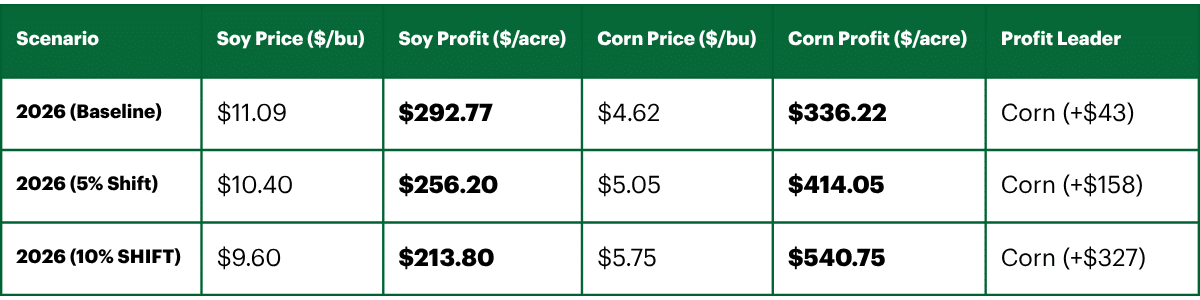
Note: These are educated guesses based on gross revenue minus variable costs like seed and fertilizer. They don’t account for land rent, but the trend is undeniable.
The question for the resilient farmer is: How do I protect my 2026 yield when the fertilizer market is physically running dry?
The Solution: Making 1 Unit do the Work of 10
The traditional method of dropping raw chemical nitrogen on soil is profoundly inefficient. Estimates show that 60% to 80% of applied nitrogen is lost to leaching and evaporation before the plant can ever utilize it. You are paying for 100 units to get the benefit of 30.
The TeraGanix Nitrogen Reduction Program is built to solve this efficiency gap. Our protocol is centered on a Biological Off-Ramp that allows growers to cut synthetic inputs by 50% while maintaining full yield potential.
How it Works:
Instead of “dumping and hoping,” we lead with a biological system that makes nitrogen work where and when the plant actually needs it.
We convert nitrogen into amino acid forms and deliver it through a targeted foliar application-right at peak vegetative demand-when the plant is actively building biomass, not filling grain.
That means faster uptake, minimal loss, and significantly higher efficiency per unit applied. In many cases, growers are seeing each unit of nitrogen go multiple times further compared to conventional programs.
We aren’t just adding biology, we are changing the delivery engine of the farm. We are helping farmers move from a system of high-waste chemistry to one of high-efficiency biology.
A Make-or-Break Moment
We believe in agricultural resiliency, but we also recognize that 2026 is a make-or-break year. For many farmers, this biological transition is no longer a nice-to-have experimental trial. It’s the only viable option to protect the farm’s solvency.
Because of the surge in demand, our team is currently slammed on the phones helping farmers write their 2026 protocols. We know that getting into a biological program requires a lead cycle for logistics and planning, which is why we are hosting weekly workshops to get as many farmers off the cliff as possible.
The global fertilizer monopolies and geopolitical conflicts are outside of your control. Your nutrient use efficiency is not.
Take the Next Step:
We invite you to join one of our upcoming Nitrogen Reduction Workshops held every Tuesday and Thursday morning. We will walk through the specific math of the program, review our latest 2025 case studies, and help you calculate your potential savings.
Register for the Nitrogen Strategy Workshop
Reserve your spot today. Let’s make sure you have the protocols and the supply you need to stay in the game this season.
Calculate Your Potential Savings